The Last Five Minutes: Why Every Handmade Gift Deserves a Care Card
There's a moment every maker knows. The gift is finished, wrapped, handed over, and the recipient is doing that delighted face — and then they ask the question. Can it go in the machine? And you realise, with a small internal wince, that you have absolutely no idea, or that you do know but you never wrote it down.
That gap is what a care card fills. Not the fancy letterpress thing you've seen on Instagram, just a small bit of card with a few honest lines on it. It takes about five minutes. It is, genuinely, the highest-value five minutes in the whole project.
Why a Care Card Is Worth the Faff
Most handmade gifts don't fail because they were badly made. They fail because somebody put a pure wool jumper on a 40°C cycle, or tumble dried a cotton tote that was always going to shrink, or left a beeswax candle burning next to an open window.
A care card does three jobs at once. It stops the accidental ruin. It gives the recipient permission to actually use the thing rather than keeping it in a drawer for best. And it quietly says I thought about you after I handed this over, which is a nicer message than any ribbon.
If you ever sell at a market or a school fair, honestly, it's near-essential. Buyers expect it, and it makes a handmade item feel finished rather than halfway there.
What Actually Goes on the Card
You don't need much. Six lines will do, and half of those you already know off by heart.
- What it is — a line of description, because in three years nobody remembers.
- Who made it and when — your name and the month. It matters more than you'd think.
- What it's made from — yarn brand and fibre content, fabric type, wax type, flour and fats if it's edible.
- How to wash it — temperature, cycle, by hand or not, and whether it can be wrung out.
- How to dry and store it — flat, hung, away from radiators, in a tin, out of sunlight.
- What to do if it goes wrong — a snag, a loose seam, a wick that tunnels. Plus your number or email.
The golden rule: be specific. 'Wash carefully' is not information. 'Machine wash at 30°C on a gentle cycle, dry flat, do not tumble dry' is information.
The Beginner's UK Laundry Symbol Cheat Sheet
You don't need to memorise every symbol on the label of your own coat. You only need the handful that turn up on handmade items.
| Symbol | What it means | What to write on your card |
|---|---|---|
| Washtub with 30 or 40 | Machine wash at that temperature | 'Machine wash at 30°C, gentle cycle' |
| Hand in a tub | Hand wash only | 'Hand wash cool, do not wring' |
| Tub with a cross | Do not wash | 'Spot clean only' |
| Triangle with a cross | Do not bleach | 'No bleach — it will yellow the fibre' |
| Square with a circle, crossed | Do not tumble dry | 'Dry flat, away from radiators' |
| Iron with one dot | Cool iron | 'Cool iron on the reverse' |
| Circle with a cross | Do not dry clean | 'Not suitable for dry cleaning' |
Two things worth adding in words, because symbols alone don't cover them. Dry flat is the instruction people ignore and the one that saves a knitted garment's shape. And wash with similar colours is worth a mention for anything hand-dyed, because the first wash is where a homemade dye job reveals its true feelings.
If you genuinely don't know how something should be washed, write 'hand wash in cool water and dry flat'. It's rarely wrong and it's always safe.
Five Low-Effort Ways to Make the Card Feel Like Part of the Present
A care card shouldn't look like a receipt tucked in the bottom of a bag. A few small tweaks turn it into part of the unboxing.
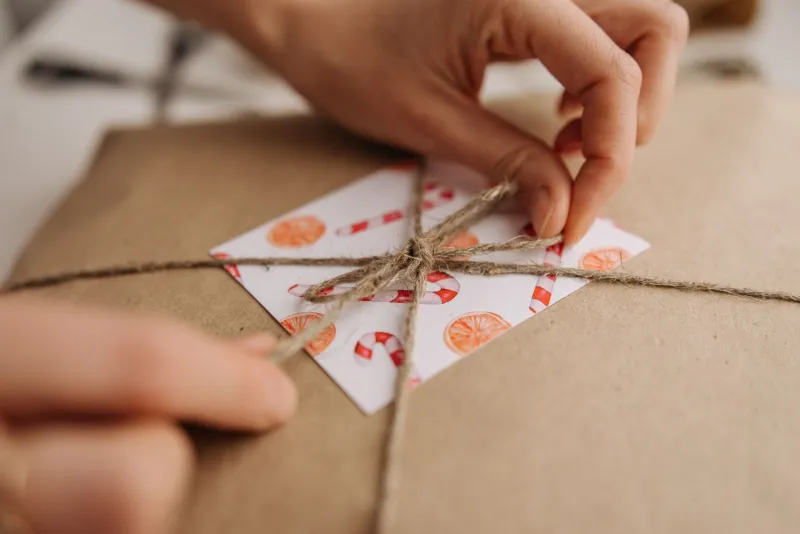
1. Turn it into the swing tag. Punch a hole in the corner, thread it with baker's twine, and tie it to the handle of the tote or around the scarf. One object instead of two.
2. Sew a small fabric label into the seam. Write on a scrap of cotton tape with a fine permanent marker, or print onto printable fabric. Stitch it inside the tote's side seam or along the scarf's cast-off edge. It'll survive the wash, which the card won't.
3. Write it inside the box lid. If you're gifting in a shoebox or a pretty tin, a few lines in neat handwriting on the inside of the lid feels like a secret message rather than an instruction leaflet.
4. Add a story line. One sentence about where the yarn came from — a charity shop jumper you unravelled, a Welsh wool mill, your nan's button tin — turns a care card into something people keep.
5. Make it do double duty for food gifts. For biscuits, brownies or a jar of marmalade, add the storage line and a plain allergen note ('contains dairy, wheat, nuts') on the same card as the 'eat within two weeks' instruction. It's the same piece of card, doing two jobs.
Quick Care Notes by Make
If you're batching a few gifts, these are the lines you'll reuse most.
Knitted and crocheted items: fibre matters far more than the pattern. Superwash merino can usually take 30°C on a wool cycle; untreated wool, alpaca and most hand-dyed yarns want hand washing in cool water with a wool wash, then a gentle squeeze and flat drying. Never wring, never hang wet.
Sewn fabric items: pre-wash your fabric before sewing if you can — it saves the recipient from discovering shrinkage for you. Cotton totes and aprons are usually fine at 30°C. Anything with interfacing, fusible wadding or a stiffened base should be spot cleaned.
Candles: trim the wick to about 5mm before every burn, burn for two hours on the first go so it pools evenly, never longer than four hours at a stretch, and keep it away from draughts and anything flammable. Say so on the card — it's the difference between a candle that lasts twenty hours and one that tunnels in forty minutes.
Bath melts and soap: keep them dry between uses, and note any essential oils, especially for anyone pregnant or with sensitive skin.
A Template You Can Copy
Made by: [your name], [month and year] What it is: [one line] Materials: [yarn and fibre / fabric / wax / ingredients] Washing: [temperature, cycle, hand or machine] Drying: [flat / line / no tumble] Ironing: [cool / not needed / on the reverse] If it needs a repair: [your email or phone]
Write it out by hand, type it up and print six to a page, or stamp it if you're that way inclined. Whatever gets it done.
One Last Thing
Take a photo of each card before it goes out. Then when someone texts you in March asking whether the blanket can go in with the towels, you can just send the picture. Small habit, saves a whole conversation, and it means you'll never again have to say 'I think it's probably fine?' about something you spent three weeks making.